
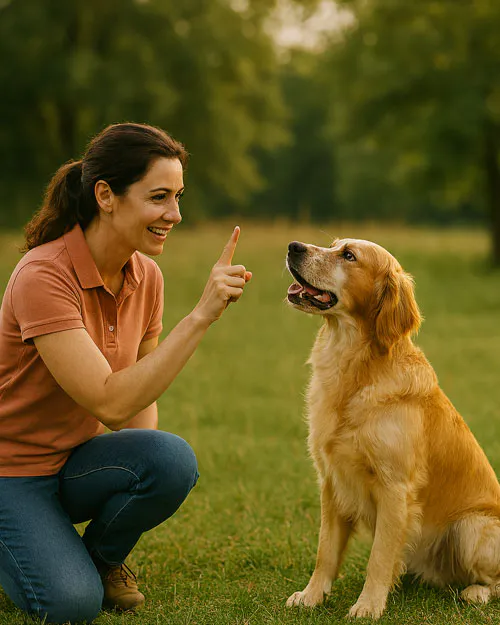






How do I teach my dog to sit? And why?!
Teaching a dog to sit is one of the most valuable foundations in training.
It's often the very first behaviour introduced because it is simple and practical, and is more than just a trick: it also provides an easy tool for controlling unwanted actions such as jumping up, barging through doors or pulling for attention. A dog that understands how to sit on cue is easier to manage in daily life, safer in public and more welcome in social situations. It also lays the groundwork for more advanced behaviours such as stay, wait or down.
Jump to FAQs
How to do it
To begin, prepare a handful of small, tasty treats that your dog enjoys. Choose a quiet space with minimal distractions and a surface that is not slippery, such as a carpet, rug, or patch of grass. Stand in front of your dog and hold a treat close to its nose. Slowly move your hand upwards and slightly back over the dog’s head. The natural response will be for the dog to lift its head to follow the treat, which shifts its weight backwards and encourages its bottom to lower to the ground. The moment the dog’s bottom touches the floor, mark the behaviour with a clear signal “yes” or a click from a clicker, and immediately give the treat. This instant connection between the action and the reward is what helps the dog understand what you want.
Repeat this process several times in short sessions of just a few minutes. Dogs learn best in brief, positive bursts rather than long drills. Once your dog is reliably sitting when you use the hand movement, you can introduce the verbal cue. Say the word “sit” at the exact moment your dog begins to lower its bottom, not before. If you say it too early, the dog may not connect the word with the action. Over time, the dog will learn to associate the word with the behaviour and respond without needing the lure.
You can try a shortcut of just using the word "sit" to begin with, and it can sometimes be successful, but it can also confuse the dog. See the FAQs below for an explanation.
As your dog becomes more confident, begin to phase out the lure. Instead of holding a treat in your hand, use the same hand movement without food, and reward from your other hand once the dog sits. Gradually reduce the frequency of treats, replacing them with praise, play or access to something your dog wants, such as going outside. This ensures the behaviour remains reliable even when food is not present.
To build reliability, practise in different rooms of the house, then in the garden and eventually on walks. Dogs do not automatically generalise behaviours, so they need practice in a variety of settings. Once your dog can sit in familiar places, add distractions. Ask for a sit when someone knocks at the door, when another dog passes by or before you put down the food bowl. Always reward generously when your dog succeeds, and if it struggles, reduce the level of distraction and build up again gradually. Never push your dog’s bottom down to force the position, as this can cause confusion or discomfort. Instead, rely on patience and repetition.
Puppies can begin learning to sit as soon as they come home, often from eight weeks old, but older dogs can learn just as well. The key is consistency, timing and positive reinforcement. At first, reward the instant your dog sits, but later you can extend the time before giving the reward, teaching patience and self‑control. If your dog refuses to sit, check your technique. Moving the treat too high may cause the dog to jump rather than sit, so keep the lure close to the nose and move slowly. If your dog only sits at home, remember that dogs need practice in different environments to understand that the cue applies everywhere.
In short, teaching sit is not only about obedience but about communication. It shows your dog how to succeed and gives you a tool to manage everyday situations calmly and safely. With patience, consistency and clear rewards, you will have a dog that responds quickly and politely, ready to build on this foundation for all the training to come.
FAQs about teaching a dog to sit
Can I skip the yes/marker step and just teach "sit"?
Seems like an obvious yes, doesn't it? But actually, this question really gets to the heart of how dogs learn. The reason trainers often recommend using a neutral marker like “yes” or a clicker before introducing the word “sit” is because of timing and clarity.
When you first start, your dog doesn’t know what “sit” means. If you say “sit” before the dog has any idea what to do, the word is just noise. By contrast, a marker word like “yes” is not meant to be the command – it’s a signal that you'll keep using throughout the dog's life, meaning “that thing you just did is correct, and a reward is coming”. It’s like taking a snapshot of the behaviour at the precise moment it happens.
If you skip the marker stage and just say “sit” from the beginning, some dogs will still figure it out, especially if you’re consistent with luring and rewarding. But the risk is that the word “sit” gets muddled because the dog hears it without a clear link to the behaviour. That can slow learning or create a weak response later. Using a marker first makes the learning sharper and faster, because it isolates the exact behaviour you want.
So, yes, you can skip the marker and go straight to “sit”, but you’ll often get a cleaner, more reliable result if you separate the two steps: first teach the action with a marker, then attach the cue once the dog understands what earns the reward.
At what age can I start teaching sit?
Puppies can begin learning sit as soon as they come home, often from 8 weeks old. Keep sessions short and fun.
Do I always need treats?
Treats are essential at the start, but over time you can reward with praise, toys, or access to something your dog wants (like going out for a walk).
What if my dog won’t sit?
Check your lure movement – if you move the treat too high, your dog may jump. Keep it close to their nose and move slowly. Practise in a calm environment before adding distractions.
Should I say “sit” before my dog does it?
No. Say the cue as your dog begins to sit. If you say it too early, they may not connect the word with the action happening or just happened, rather than a command to do the action.
How long should my dog hold the sit?
At first, reward the instant they sit. Later, you can gradually extend the time before rewarding, teaching patience and self‑control.
Can older dogs learn to sit?
Absolutely. While puppies may pick it up quickly, older dogs can learn too. Just be mindful of any joint issues that can make sitting uncomfortable for some older dogs.
What if my dog only sits at home?
Dogs don’t generalise well. Practise in different places and reward generously until the behaviour is reliable everywhere.