

Share this article about
Introduction to dog training






What do you need to know to begin training your dog effectively?
Many people believe that dogs instinctively know how to behave in a human household, but the truth is that every dog, regardless of breed or age, needs guidance.
Training is not about forcing obedience but about building a shared language that allows both dog and owner to live together harmoniously. This article explores why training matters, how approaches have changed over time, the basic techniques that form the foundation of good behaviour, the areas where experts disagree, and answers to the most common questions asked by new and experienced owners alike.
Purpose & Function
Training serves several purposes. At its most practical level, it ensures safety. A dog that responds to recall is less likely to run into traffic or chase livestock. A dog that understands boundaries is less likely to bite out of fear or confusion. Beyond safety, training provides mental stimulation that dogs absolutely love. They're intelligent animals that thrive when given tasks and challenges, and they love to please. Without this stimulation, though, they may turn to destructive behaviours out of boredom.
Dog training used to be mostly based on dominance, with handlers encouraged to assert themselves as the pack leader, but this approach has largely been discredited. Modern training emphasises positive reinforcement, where desirable behaviour is rewarded and undesirable behaviour is redirected rather than punished. This shift came about thanks to a better understanding of dog psychology and recognising that trust and cooperation are far more effective than fear and domination.
Training also strengthens the bond between dog and owner, because working together on tasks builds mutual respect and understanding. It allows the dog to feel secure in its role within the household and gives the owner confidence in managing different situations. Think of training not just about control but about creating a partnership.
How to do the basics
Principles of training
At its core, dog training is built on two main principles:
-
clear communication in one or two words: if you say, "please come here, there's a good boy, come here, I have a treat for you...", the dog's going to hear a load of words and have no idea which one to pay attention to. Adding a visual signal at first can help reinforce the dog's understanding that you're telling it something.
-
consistency: if you tell the dog to "come here” one day and "get back" the next, the dog will quickly become confused and start ignoring it. Keep the words (and signals, if you use them) the same EVERY time.
Dogs learn best when they understand exactly which behaviours are rewarded and which are not.
This is achieved through positive reinforcement and consistent timing:
-
positive reinforcement: rewarding desired behaviour with treats, praise or play. It strengthens the bond between dog and handler while encouraging the dog to repeat the behaviour.
-
consistent timing: the reward must come immediately after the behaviour so the dog can make the connection. A minute later, and the dog might think you're rewarding whatever it's doing at that moment instead.
Another key principle is shaping behaviour through gradual steps. Instead of expecting a dog to master a complex task all at once, trainers break it down into smaller, achievable actions. For example, teaching “stay” might begin with a one‑second pause before gradually extending the duration and distance.
And finally, patience and repetition help reinforce learning, while keeping sessions short and engaging prevents frustration. Ultimately, effective training is less about control and more about building trust, creating a cooperative partnership where the dog feels secure, motivated, and eager to learn.
Now we understand the principles and techniques, let's learn some basic skills! Each one presented here includes a link to a longer article with more detail; this is just to give you the basic ideas for now.
Basic skills
One of the first and most important skills to teach is recall. Start in a quiet environment with minimal distractions. Call the dog’s name followed by a cue such as “come”. When the dog approaches, reward generously. Gradually increase the level of distraction and distance as the dog improves. Recall is not only useful in daily life but can be lifesaving. More information on recall can be found here, and there are some recall games here, which help reinforce the idea and can be fun for you and the dog.
Another essential skill is loose lead walking. Dogs naturally move faster than humans, so pulling is common. To teach loose lead walking, stop moving whenever the lead tightens. Only continue when the dog returns to your side and the lead slackens. This teaches the dog that pulling does not achieve forward movement, while walking calmly does. There's more information on loose lead walking here.
Sit and stay are further basics. These positions help manage the dog in busy environments and provide structure.
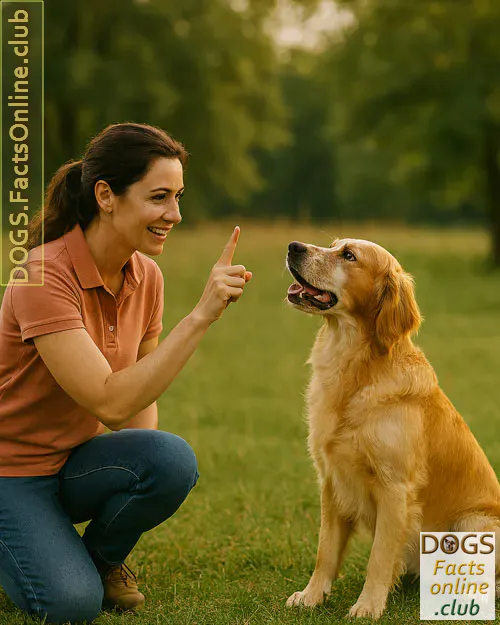
Teaching sit can be as simple as holding a treat above the dog’s nose and moving it back until the dog naturally lowers its hindquarters. Mark the behaviour with the word "sit". Some people raise a hand, palm facing the dog, at the same time as this can reinforce the idea that you're commanding the dog to do something. Try it if you like, then drop it once the dog sits on command. You can find more help with teaching your dog to sit on command here.
Stay is a bit trickier and takes patience, building the duration gradually from a second or two to as long as you need the dog to remain somewhere. To teach a dog to stay, begin by asking for a sit in a quiet space, then give command "stay" with a clear hand signal. If the dog stays, give a reward after only a second or two. If it doesn't, withhold the treat, reset and start again. It's surprising how quickly the dog will understand. Once the dog gets the basic idea, gradually increase the time before rewarding. It's important at this stage that you always return to the dog rather than calling it over, just to keep things simple. Once the dog is reliable with short durations you can add greater distance and even some mild distractions. Finally, introducing a release word such as “okay” helps the dog understand when the exercise is finished. With steady practice, the stay becomes a dependable skill. More information on teaching stay can be found in this article, and the difference between 'wait' and 'stay' is covered in this article.
This last item in this list isn't actually about training but it's so important, it has to happen very early on and goes hand-in-hand with these training basics. We're talking about socialisation, which is essential for all dogs but particularly for puppies. Lack of socialisation is almost a guarantee of fear and aggression later in life.
Socialisation simply means calmly letting the dog meet other people, animals, sounds and environments; the more this happens without the dog overreacting or panicking (or you shouting!), the more this will teach the dog that the world is actually a nice place for it to be. Socialisation should be positive and controlled, never overwhelming. Even for older dogs, careful exposure can still improve confidence and reduce reactivity. More info on socialisation here.
Grey Areas & Controversies
Despite broad agreement on positive reinforcement, there are still debates within the training community. One area of disagreement is the use of aversive tools such as prong collars or electronic collars. Some argue that these can provide quick results in difficult cases, while others maintain that they risk causing fear and damaging the relationship between dog and owner. Many professional organisations advise against their use, but opinions remain divided. If you're considering using any such devices or methods, please do some research first, and definitely talk to other dog owners and vets.
Another grey area is the question of whether dogs will try to dominate 'weak' humans. The dominance model has been widely challenged, yet some trainers still frame behaviour in those terms. Research suggests that dogs do not view humans as pack members in the same way they view other dogs, and that most unwanted behaviours stem from confusion, fear, boredom or lack of training rather than attempts at dominance.
There is also debate about the role of food in training. Some owners worry that using treats creates dependency. In practice, food is a powerful motivator, and once a behaviour is established, rewards can be varied and phased into everyday life. For example, a dog may sit because it has learned that sitting often leads to something good, whether that is food, play or attention.
Summary
These are just the basics that all dogs and dog owners should know and practise, but it doesn't stop there: training a dog is not a one‑time project but an ongoing process that adapts as the dog matures and circumstances change. By approaching it with patience and consistency, owners can create a relationship built on trust and clear communication. The effort invested at the beginning pays off in a companion who is both well‑mannered and confident, making life together more enjoyable for everyone.
Frequently Asked Questions about basic training techniques
How do I stop my dog barking when left alone?
Excessive barking when alone is often a sign of separation anxiety. The dog may also chew or damage items in the house. The key is to address the underlying distress rather than punish the barking. Gradual desensitisation, where the dog is left alone for short periods that are slowly increased, can help. Providing toys that occupy the dog, ensuring adequate exercise before leaving, and creating a safe space such as a crate or quiet room can reduce anxiety. In severe cases, professional help from a trainer or behaviourist may be needed.
Does my dog want to dominate me if he pulls on the lead or walks in front?
No. Pulling on the lead is usually a sign of excitement or lack of training rather than dominance. Dogs naturally move faster than humans and are curious about their environment. Teaching loose lead walking through consistent practice is the solution. The idea that dogs seek to dominate humans is based on outdated interpretations of wolf behaviour and does not reflect modern understanding of canine psychology.
Should I let my dog sleep on my bed?
This is a matter of personal choice rather than a training rule. Allowing a dog on the bed does not create behavioural problems in itself. What matters is consistency. If you prefer the dog to sleep elsewhere, provide a comfortable alternative and reward the dog for using it. Some owners find separate sleeping arrangements helpful if the dog is restless or if allergies are an issue.
If I train with food, will I always need to use food?
Food is an effective way to teach new behaviours because it provides immediate motivation. Once the behaviour is learned, rewards can be varied. Praise, play, access to the outdoors or attention can all reinforce behaviour. Over time, the dog learns that good behaviour often leads to positive outcomes, not just food.
Why does my dog bark at the doorbell?
Dogs bark at the doorbell because they quickly learn that it signals the arrival of someone new. To dogs, someone new just equals excitement. To manage this, you can teach an alternative behaviour such as going to a mat or sitting quietly when the bell rings. Practise by ringing the bell yourself and rewarding the dog for the desired response. With repetition, the dog learns that calm behaviour brings rewards.
Why do dogs pull on the lead?
Dogs pull because they have not yet learned that pulling does not get them where they want to go. Stopping whenever the lead tightens and moving forward only when it slackens teaches the dog that calm walking is the way to progress. Consistency is essential, and patience is required, especially with young or energetic dogs.
Is treat training bribery?
No. Using food to teach behaviour is not bribery but reinforcement. Bribery would mean showing the food before the behaviour to coax the dog. Proper training uses the food after the behaviour to strengthen the association. Over time, the dog responds to the cue itself, and food becomes one of many possible rewards.
Should I train my dog to protect me?
Definitely not! Teaching a dog to attack or guard is only appropriate in professional situations, otherwise it could backfire on you or innocent people if the dog misunderstands any cue. A well‑trained dog will naturally alert you to unusual activity and will naturally be defensive of you and other family members, so encouraging aggression is unnecessary and potentially disastrous.
Why is my dog hyperactive?
High energy often results from lack of exercise or mental stimulation. Providing regular walks, play sessions and training tasks helps the dog learn to settle. Try hiding treats around the house – finding them is mental stimulation and tiring. Teaching calm behaviours and rewarding relaxation can also reduce hyperactivity.
Will giving my dog food from the table cause begging?
Begging is caused by the act of feeding from the table, not by the type of food. If you do not want your dog to beg, avoid giving food while you are eating. Instead, feed the dog at its own mealtime or provide a chew or toy during yours. Once you sit down to eat, though, the dog needs to understand that you (and your food!) are strictly unavailable. Many dogs who have learned this will happily and automatically take themselves to their bed or favourite chair.
What is the purpose of training older dogs?
"You can't teach an old dog new tricks". Yes you can! Older dogs can still learn new behaviours and benefit from training. It provides mental stimulation, helps manage age‑related changes and strengthens the bond with the owner. While puppies may learn faster, older dogs often have better focus and patience. Happy older dogs will sometimes teach themselves new routines or games... and it's a joy to see.
How has training changed over the years?
Training has shifted from dominance‑based methods to positive reinforcement. This reflects a better understanding of canine behaviour and a move towards approaches that build trust rather than fear. Owners today have access to a wide range of resources, from classes to online tutorials, making training more accessible than ever.